Dry Creek Community Park
Community Park Hours: 5 am to 11 pm
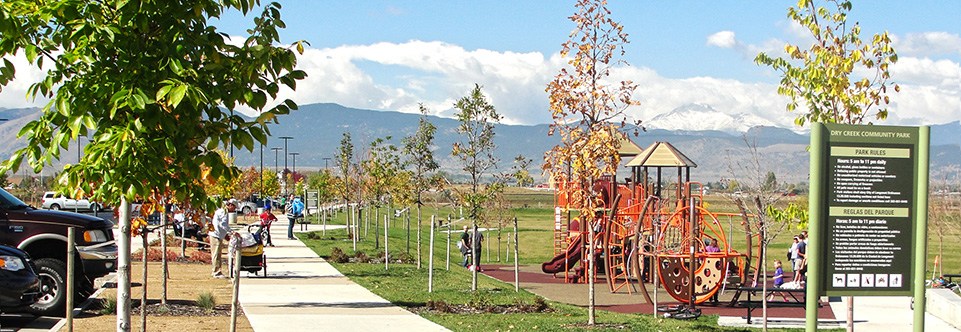
Dry Creek Community Park is a 23-acre park named for the creek running through the site. Amenities at the park include a multi-tiered and ADA accessible playground, restrooms, parking, walking paths and Dry Creek Greenway trail connection from Grandview Meadows Drive to Blue Skies Park, an 18 hole disc golf course, and a sledding hill. There is also a multi-use sports field including cricket pitches.
Visit the Dry Creek Community Park development page.
The amenities currently available at the park represent Phase 1 of development of the park. To view the full Dry Creek Community Park Master Plan and learn more about future development of Dry Creek Community Park visit our Park & Trail Development, Plans, Maps and Reports webpage.
Reservations and Permits
Plans, Maps and Reports
Renewal and Reinvestment
Feedback on Dry Creek Park Updates
"I wanted to give some feedback on our first days at Dry Creek Park. It was amazing! I am the owner and manager of Longmont Indoor Soccer and Boulder Indoor Soccer. Dry Creek is our best facility venue for either business. Boulder has nothing like this facility and the community was in awe. The parking lot has ample parking. The field turf is awesome, flat, and professionally installed. The lights! Oh, the lights came on and it took the place to another level. The directive style lighting was top notch. The 200 + families in our program were thrilled to be at Dry Creek. They loved the location, lights, turf, and field space. We had three new families join this week who live in the immediate area who were so pleased to see our program at the park. Longmont is growing and the facilities need to grow as well. You hit the mark with this new facility. It was worth waiting for the past couple of years. Thanks to everyone involved in the project. The community thanks you, the soccer community thanks you, and I as a citizen of Clover Creek Neighborhood for the past 25 years, thank you very much." – Peter Ambrose
Dry Creek Community Park General FAQs
This was identified as a need for a community park location in the City of Longmont Comprehensive Plan and is reflected in the adopted Parks, Recreation and Trails Masterplan.
Community Parks are larger sites developed for active recreational use. Existing sites range in size from 20 – 100 acres and provide space for indoor and outdoor recreation facilities such as pools and recreation centers. These sites are spread across the city and augment the neighborhood park access with larger recreation facilities and gathering places, typically featuring multiple lighted ball and/or multi-use fields, aquatic facilities, playgrounds, multiple sport courts, multiple restrooms and recreation or community centers.
Neighborhood Parks are the basic building block of the system and provide space for close-to-home recreation activities. Existing sites range in size from under 2 acres to 16 acres. The ideal neighborhood park is central to and easily accessible from the neighborhood. Sites are often located adjacent to elementary school sites, which can enhance the site’s acreage, and offer convenience to one of the critical user groups, children, and their families.
Nature Area means a designation of public land that is developed to provide access to and enjoyment of important natural, historic, and cultural resources and allow for limited, low impact, and passive outdoor recreational uses that fit the unique natural characteristics of the area. Examples include Dickens Farm Nature Area, Golden Ponds Nature Area, Izaak Walton Nature Area, McIntosh Lake Nature Area, Rogers Grove Nature Area, Golden Ponds, McCall Lake Nature Area, Sandstone Ranch Nature Area, St. Vrain Greenway, Union Reservoir Nature Area, Jim Hamm Nature Area.
Open Space Purchased with Open Space Funds from the 0.2-cent sales tax (per Municipal Code 4.04.130.I) shall serve one or more of the following functions:
i. Preservation of natural areas, wildlife habitat, wetlands, agriculture, and visual corridors.
ii. Link and trails, access to public lakes, streams and other usable open space lands, stream corridors and scenic corridors along existing highways.
iii. Conservation of natural resources, including, but not limited to, forest lands, range lands, agricultural land, aquifer recharge areas, and surface water.
iv. District parks (nature areas) devoted to low-impact recreational uses.
v. Implementing greenways and open space policies or strategies of the city area comprehensive plan.
vi. Urban shaping buffers between or around municipalities or community service areas and buffer zones between residential and nonresidential development.
Once the City of Longmont’s Park System is built out, the intent identified in the Parks, Recreation and Trails Masterplan is that all residences within the City of Longmont would have access to neighborhood parks within ½-mile and access to community parks within 1-mile. Both the Longmont Comprehensive Plan and the Parks, Recreation and Trails Masterplan reference these metrics. NRPA (National Recreation and Park Association) Park Metrics, which is the most comprehensive source of benchmarks and insights for park and recreation agencies, identifies the standard distance to a neighborhood park as ¼ to ½-mile and the standard distance to a community park as 1 to 2 miles.
The distance to the park is determined by utilizing the Network Method, which is measured along pedestrian networks of sidewalks and trails. The closer, ½-mile service area for neighborhood parks is based on the typical walking distance most pedestrians are willing to travel to reach nearby destinations such as a neighborhood parks. The longer, 1-mile service area is based on the distance most people are willing to bike, drive or take transit to destinations with a city-wide draw such as a community park. This distance is a balance between spacing these recreation facilities out and keeping them close enough to not force travel by personal auto.
Per the City of Longmont Parks, Recreation and Trails Masterplan, the Park Land Standard (acres/1,000 residents) was set at 2.5 acres/1,000 residents for neighborhood parks and 4.5 acres/1,000 residents for community parks.
The standards established in the Parks, Recreation and Trails Masterplan are in close alignment with the NRPA Parks Metrics, which recommend a neighborhood park standard of 2.0 acres per 1,000 residents and a community park standard of 5 to 8 acres per 1,000 residents. According to the 2024 inventory of developed parkland and the 2020 census population data, the total park acreage falls slightly below the neighborhood park standard of 2.0 acres per 1,000 residents, missing the target by 0.5 acres per 1,000 residents, or 49.45 acres in total. For community parks, the shortfall is more pronounced, with developed parkland falling 2.0 acres per 1,000 residents below the standard, totaling 196.40 acres under the recommended benchmark.
The development of park land in the City has not managed to keep pace with the population growth that has occurred which will only continue to lower the actual acres/1,000 residents until additional park land is funded to be developed.
- Clark Centennial Community Park, 47.7 developed acres
- Dry Creek Community Park, 23 developed acres, 58 undeveloped acres
- Garden Acres Community Park, 41.6 developed acres
- Quail Campus Community Park, 18 developed acres, 26 undeveloped acres
- Roosevelt Community Park, 19.4 developed acres
- Sandstone Ranch Community Park, 99.4 developed acres, 35.1 undeveloped acres
- Sister’s Property (future community park site, name is a placeholder), 69.3 undeveloped acres.
- Montgomery Farm (future community park site, name is a placeholder), 80 undeveloped acres.
81 acres total, 23 acres were developed during the first phase. 58 acres remain to be developed in the second phase.
City staff (planning, recreation, parks, land program administrator, community services, city manager), surrounding neighbors, St. Vrain Valley School District, community park recreational groups and members of the wider community.
In 2007, initial design input occurred thru: Stakeholder meetings (community members, SVVSD, City staff, recreational groups), Tamales and Talk session for Latino community, comment cards, hotline voice mailbox, on-line survey, email/phone contact with City Project Managers, SVVSD meetings with administration and students via school classes.
Posting of design display boards at: Longmont Recreation Center, Public Library, Senior Center, Centennial Pool, and Silver Creek High School (comment cards were included at each of these sites). In addition, further public outreach occurred thru Longmont Times-Call. Draft Master plan brought to Parks and Recreation Advisory Board as an information item.
Formal City Council approval of the master plan was given on November 18, 2008.
In January 2024 a community meeting was held at Altona Middle School to inform the public about the upcoming construction of synthetic turf, sports lighting, and resilient St Vrain fill material borrow area.
Yes, once this project is funded and approved by City Council to move forward, public engagement will occur to solicit feedback from the community regarding the Phase 2 park design.
No, the future park west of Mountain Drive in the West Grange Subdivision has not been master planned/designed to date.
There has not been any design that has occurred for Dry Creek Community Park Phase 2 beyond the masterplan.
Currently this phase is unfunded in the adopted Capital Improvement Program budget. The timeframe is to-be-determined due to a lack of available funding.
Yes, there will be a community-wide outreach to solicit input/feedback on the Phase 2 park design prior to construction once the project is funded and approved to move forward by City Council.
The fields did not perform well as the natural turf did not thrive due to high salinity soils and high groundwater. The City received many requests to improve performance of the surface of the fields. The result was to invest in synthetic turf which will result in maximizing the playability of the fields throughout the year and best meet the need of our sport community.
In the Mountain West and Colorado Front Range, synthetic turf temperatures on sunny, calm days have been typically measured at 20-40 degrees above the ambient temperature at points directly on the turf or near the surface. The higher above the surface, the lower the temperature. If wind is present, the temperature will also be lower. These temperatures could prompt changes in programming during the hottest months spanning mid-July to mid-September during the hottest parts of the day. The remaining 9-10 months will benefit from the temperature of the turf as the synthetic turf doesn’t freeze hard like natural turf and stays more pliable all winter.
An irrigation system with quick couplers is installed for cleaning the fields. Additionally, the utilized sand infill has antibacterial coating.
The fields will be spot cleaned on an as-needed basis. This is a standard practice for cleaning synthetic turf fields.
- Turf: Worldwide Turf Allsport Ultra tufted turf
- Pad: Enplast ShockDrain 580
- Fill: UniWest OptiFILL+ (antimicrobial coated turf sand)
- Turf Seam Adhesive: Mapei Ultrabond TurfPU 2K
- Turf Tape: Mapei Ultrabond Turf Tape
No, the bill specifically excludes athletic playing fields from the restrictions on artificial turf installation.
- The turf was tested for fluorine content. The results shows that the fluorine content in the TenCate XP Fiber material was below the detection limit of 1.0 ppm. This suggests that the material either does not contain fluorine or contains it in such a low amount that it is below the threshold of detection for this test method. A copy of this test is available upon request.
- TenCate is a zero-waste field solution. Each field is assigned a reference number which follows it throughout the entire processing cycle at end of life. The turf is initially processed at the TenCate Turf Recycling Solutions facility; once this processing is complete, a certificate is issued for the customer. The processed turf is then assigned a lot number and transported to the Advanced Recycling facility. Once the turf has gone through the advanced recycling process, confirmation is sent to TenCate Turf Recycling Solutions and shared with the customer. Turf processing rate is $0.15/sq.ft. plus the cost of freight. There are roughly 252,670 s.f. of turf installed.
- Infill material consists of coated sand in lieu of rubber infill. Sand infill generally offers several environmental benefits over rubber infill, including reduced chemical exposure, lower heat retention and better end-of-life management. Coating provides antibacterial qualities and reduces abrasiveness.
- The project is following all local and federal regulations regarding sustainable site development.
- Construction permits acquired for the project include:
- Colorado Department of Public Health and Environment CDPS (Colorado Discharge Permit System) COR400000 Construction Stormwater Discharge Permit (a construction stormwater permit that allows the discharge of stormwater associated with construction activities in Colorado)
- City of Longmont SCAP (Stormwater Construction Activity Permit, which is required for all activities that disturb one or more acres of land)
- City of Longmont Floodplain Development Permit (permit to ensure that proposed development projects meet the requirements of the FEMA National Flood Insurance Program and the City of Longmont floodplain regulations)
- FEMA No-rise Certification (stipulates NO impact/NO changes to the base flood elevations, regulatory floodway elevation, or regulatory floodway widths at the new cross-sections and at all existing cross-sections anywhere in the model)
- City of Longmont Electrical Permit (to ensure that electrical work meets safety codes and standards)
- Construction permits acquired for the project include:
Community parks emphasize active recreation, whereas nature areas prioritize wildlife habitat conservation and low-impact, passive activities. However, in all projects, the city takes steps to minimize impacts on wildlife:
- A survey for nesting birds was conducted before construction began.
- Light fixtures near wetlands are shielded to limit exposure within the wildlife corridor. The lights being installed at Dry Creek are manufactured by Musco Lighting and are designed to put the light specifically on the field while having minimal spill around it. The lights are intentionally designed to preserve as much darkness as possible while providing a safe playing environment.
- Reducing light temperature was considered but found infeasible.
The lighting is dark sky compliant with full cut off fixtures.
Lights are available for use by any user group for a fee. The policy regarding light use is managed in the field rental permit and require lights to be off by 11 pm.
If there is no activity occurring, there should be no reason for the lights to be on.
While light use will vary by season (earlier sunset will mean more use of lights), most youth activity will conclude no later than 9 pm on weeknights, while adult activity may extend typically until 10 pm. Based on use at other parks, weeknights will typically see more use of lights than weekends, though this may fluctuate depending upon game or tournament use as opposed to practice.
Access to the St. Vrain Valley School District facilities have been inconsistent and limited. The investment into the City’s only synthetic turf space was made to ensure the community has adequate quality sports field space. Lighting of these fields for maximum utilization as a primary driver in meeting community sports demand. As a community park, lighted field space is integral in all sports field spaces. Since 2008, the population of Longmont has increased significantly. Dry Creek Park is the only community park serving residents in Southwest Longmont.
FACILITY RULES:
- No event may begin prior to:
- 9:00 AM January to April and October to December or
- 8:00 AM May to September.
- All events must be completed (lights out) by 11:00 PM.
- The use of alcoholic beverages in the Facility is prohibited.
- Glass bottles are not allowed in any City of Longmont park.
- Overnight parking or camping in the Facility parking lots is prohibited.
- Only authorized vehicles will be allowed inside the complex area. Authorized vehicles are City vehicles, maintenance vehicles, and emergency vehicles.
For athletic field rentals, interested parties should contact the Sports Office at 303-774-3527 or sports@longmontcolorado.gov. They have information packets available for both short term (one-time events) and long term (league) rentals.
The lights are reserved per the reservation and not based on a participant count.
Current field space allocations do not meet the demand of user groups. Sandstone Ranch, the City’s primary community park for sports, is allocated to the point of affecting turf health. Because demand is so great, all areas of the sports complex fields are used during March through November, not allowing appropriate time for the turf to heal. Recreation consistently turns away requests for field space as the inventory of athletic fields is not meeting demand.
The greatest deficiency in demand comes from adult soccer, youth tackle/flag football, youth lacrosse, and adult ultimate disc user groups seeking access for games and practice space. There are also locally based youth soccer teams that have sought out space in other communities as Longmont’s resources could not accommodate their needs. This demand consists of teams seeking consistent practice space to clubs seeking space for tournaments and alternate game locations across all sports.
A community information meeting regarding the new fields and sports lighting occurred at Altona Middle School on Wednesday, January 10, 2024, from 6:00 pm – 8:30 pm. Aside from that public engagement, there was not any further polling.
The top layer of the turf has a warranty of 8 years but can last 10 or more years if maintained properly. The City has planned for turf (top layer) replacement in 10 years, which will first show up in the 5-Year CIP in 2029 and will project the funds needed in 2034 for replacement. The padding that is below the turf layer has a 25-year warranty; the City will plan for padding replacement as soon as 2049. With properly allocated resources and maintenance practices, the benefit of the field outweighs the additional costs that would be incurred with natural turf over the same period while providing a superior product for the community.
The field is expected to be used year-round, even in colder winter months to meet the community demand. Local user groups are requesting field space during these months to prepare for off-season tournaments held in warmer climates. Lights will allow for significantly more use than the effective daylight times, which decrease to almost none on weeknights in November through February, despite community demand.
In 2007, initial design input occurred thru: Stakeholder meetings (community members, SVVSD, City staff, recreational groups), Tamales and Talk session for Latino community, comment cards, hotline voice mailbox, on-line survey, email/phone contact with City Project Managers, SVVSD meetings with administration and students via school classes. Posting of design display boards at: Longmont Recreation Center, Public Library, Senior Center, Centennial Pool, and Silver Creek High School (comment cards were included at each of these sites). In addition, further public outreach occurred thru Longmont Times-Call. Draft Master plan brought to Parks and Recreation Advisory Board as an information item. Formal City Council approval of the master plan was given on November 18, 2008.
A community meeting was held at Altona Middle School on Wednesday, January 10, 2024, from 6:00pm – 8:30pm to inform the public about the upcoming construction of synthetic turf, sports lighting, and resilient St Vrain fill material borrow area.
Yes, a public meeting was held at Altona Middle School on Wednesday, January 10, 2024, from 6:00 pm – 8:30 pm.
A mailer was sent out to all residential addresses within a quarter mile of the park (280 addresses). The addresses were generated by the Boulder County Assessor’s Office website.
In comparison to the Notice Distance Requirements for development review procedures required by City of Longmont Municipal Code, Table 15.02.040(2), the distance of ¼ mile (1,320 feet) exceeds the 1,000-foot minimum notification distance required by the code. When engaging public for announcements and feedback, the parks department typically utilizes a ¼-mile radius, but this can vary depending on surrounding neighborhood configurations, type of the project, purpose of engagement.
The meeting was focused on the proposed sports field lighting and provided an opportunity for the community to ask questions about the new synthetic turf fields, operating hours for the new sports fields and to bring awareness of the upcoming relocation of material at the existing sledding hill.
This park is not currently included in the 5-year Capital Improvement Program. It will be added to the 5-year plan when funding is projected to become available.
Yes, the City will solicit community feedback for the park design once it is funded and approved to move forward.
After the prairie dogs are relocated, the City will be seeding denude areas with a native seed mix and conducting weed control.
Feedback from the community will be solicited when the future park has been funded and approved to move forward by City Council.
10 acres
The City’s CIP DRN039 – RSVP Izaak Walton Reach 2 (Boston Ave to Sunset Street) will be exporting dirt from the unofficial sledding hill located on the south side of the Dry Creek Community Park parking lot. The project will also import dirt to reconstruct the sledding hill and make the site whole again. Access to the borrow material will be through the parking lot. The Army Corps of Engineers will be managing this project with support from the City.
The sledding hill will reopen in mid-August of 2026.