Neighborhood Improvement Fund
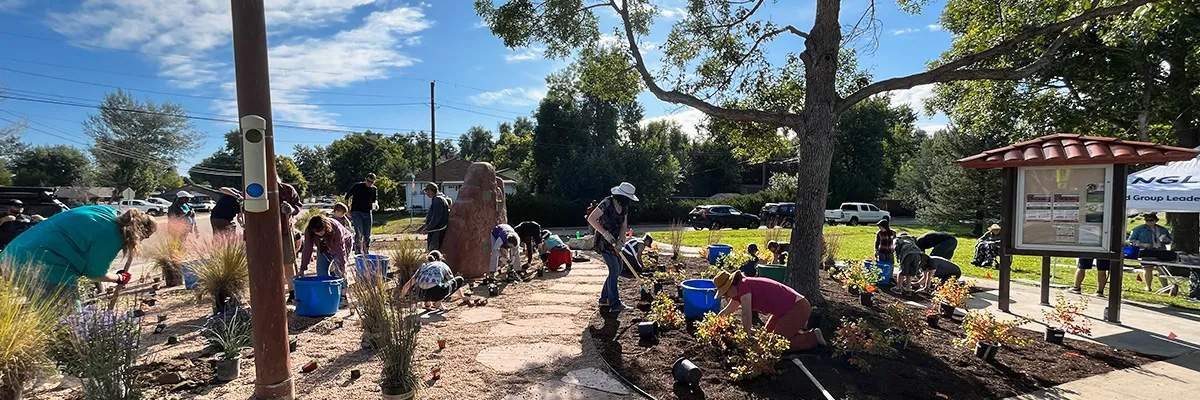
Neighborhood Improvement Funds (NIF) provide money for neighborhood projects that improve the quality of life. These grants are available only to neighborhood-based community groups active with Longmont’s Neighborhood Group Leaders Association (NGLA).*
* Active NGLA status requires a current registration and participation in at least seven NGLA meetings in the last twelve months. Visit the NGLA webpage.
The base NIF grant can provide up to $2,000 for improvement projects.
Additional funds of up to $25,000 may be available for projects that focus on:
- Water Conservation
- Food Access
- Public Health and Safety
- Transportation and Traffic Safety
- Energy and Electrification
- Waste Reduction
- Risk Reduction and Resilience
- Air Quality
Eligible Projects
Examples of base NIF grant project typically cover “quality of life” issues, including:
- Neighborhood identity and branding
- Landscaping and beautification
- Transportation and public safety
- Placemaking and community infrastructure
Ineligible Projects
Projects are not eligible if they:
- Take place outside Longmont city limits
- Include the purchase of motor vehicles, real property, alcohol or mobile phones
- Have already started or been completed
- Benefit individuals rather than the entire neighborhood
- Request salaries or operating expenses
- Hire individuals or companies that duplicate City services
- Support social, political or fraternal organizations
- Pay for field trips, admissions, cash prizes, gift cards, or for incomplete projects without secured funding
- Maintenance projects
- Fencing projects
Project Examples and Resources
Find examples, ideas and resources in the Project Library.
Funding Schedule
You can apply three times during the year. The 2026 applications deadlines are:
- February 6, 2026
- June 5, 2026
- October 9, 2026
Evaluation Process
A review committee will evaluate applications. The committee includes:
- Six voting community members
- Three non-voting representatives from the City of Longmont
What the Committee Looks For
The committee values creative, holistic projects that are easily repeated. In each they look for the following:
- Application quality (concept, plan, budget, justification)
- Public benefit and sustainability
- Community participation and contribution
- Need for the project and its lasting value
Location Details
- Project address or location
- Property ownership information
- Electricity details (who will pay, if needed)
Community Contacts
- Neighborhood name
- Project manager (name, email phone and address) – this is the main contact
- Project team members (names, roles and contact information)
Project Details
- Project title, statement, and description
- Grant request and total project cost
- Indicate if the project occurs once or is ongoing
- How the community will participate
- Why the project is needed
Budget and Implementation
- Community contribution (donated money, time, materials, services)
- Budget summary
- Required permits or approvals (city permit, HOA letter of approval, others)
- Other City departments or resources needed (and whether you’ve contacted them)
- Payment type (reimbursement, direct payment, both, other)
The grant evaluation committee will review your application to determine if you qualify for up to $2,000 in extra funding for projects that support irrigation upgrades/ fixes, xeriscaping, pollinator gardens, or other water saving projects.
Eligibility & Scope
- Applicant must be a registered Neighborhood-Based Community Group in good standing with the NGLA, eligible for the NIP grant
- The water conservation stipend is an optional add-on to support projects like irrigation upgrades/ fixes, xeriscaping, pollinator gardens, or other water saving projects.
- Projects must deliver a measurable water-conservation benefit for the neighborhood.
Minimum Application Requirements
- Description of what stipend will be used for: Applicants can use the stipend for grant matching, materials, professional labor, etc.
- Estimated water savings: Use resource-based guidance
- Follow up: Information, photos, etc. when the project is completed.
A Long-Term Maintenance Plan is Required
This plan must include:
- Roles & Responsibilities: E.g. “Gardening Team A maintains drip irrigation and mulching every spring,” “Team B checks for leaks monthly during dry season.”
- Maintenance schedule: Frequency of key tasks: e.g. annual mulch top-up, irrigation checks, aeration, or weekly weeding.
- Backup support: Identify willing volunteers or community leadership to take over if individuals change.
- Hired out maintenance: If maintenance will be contracted out, include proof of the agreement with the service provider.
Evaluation & Award Criteria
Projects will be prioritized or awarded based on:
- Water efficiency: Estimated water saved
- Replicability: Projects that are easily shared or duplicated in other neighborhoods.
- Maintenance Plan: Realistic and appropriate long-term maintenance plan
- Capacity building: Encouraging neighborhoods to plan beyond one-time work. For example, creating a neighborhood water master plan or long-term landscape strategy.
If you receive funding:
- You have a year to complete your project (unless you receive an approved extension)
- Once finished, you have two weeks to submit your payment request
Your payment request must include:
- A final project report (must show completion)
- Dated and itemized receipts or closed invoices
- The City of Longmont does not reimburse taxes.
To apply, contact NGLA staff at ngla@longmontcolorado.gov or 303-651-8556.
Frequently Asked Questions
- Neighborhood-Based Community Groups (NBCG) that have achieved ‘active’ status with NGLA. *Eligible groups may apply multiple times per year.
- Applications are accepted anytime with specific review deadlines in 2025 on January 2, March 6, May 1, July 3, and September 4.
- Requests are reviewed and awarded the month following the original applications.
- Your neighborhood may apply more than once a year.
- NIP Neighborhood Enhancement Projects (NEP): $6,000 with NLS*
* Amount requires qualifying Neighborhood Leadership Series (NLS) training participation in last 12 months.
- Quality of Life Grant: Neighborhood Identity & Branding, Landscaping & Beautification, Transportation & Public Safety, Placemaking & Community infrastructure
- *Review guidelines with staff and receive approval to submit an application (email below)
- Complete the application: https://bit.ly/NGLAGrantApp must be completed in one session
- Documents submitted with application: Budget, map, property ownership approval, maintenance plan, bids/price comparisons (+ preference letter), supplemental material
- Overall Application: concept, planning, budget, justification, quality
- Public Benefit: The project furthers one of four general quality of life public benefits (NEP) at the neighborhood scale.
- Community Participation: Broad community involvement or support
- Community Contribution: At least 10% of the project cost, aim for 25% to 50%. Options: Financial, Volunteer labor, Donated professional services, Donated materials, and Volunteer management/planning hours (<50). Typically a combination.
- Longevity: Will the project last into the future, clear maintenance plan.
- Need: Is this funding necessary for the project to occur.
- Creativity: A unique, inventive, or inspirational project or approach
- Replicability: Can other neighborhoods replicate the project
- NIP Neighborhood Enhancement Projects (NEP) are awarded by the NIP Committee
- Meet with staff, then complete the project within three months of award notification (extensions may be approved as part of project requirements or with extenuating circumstances)
- Submit payment request with acceptable proof of payment (dated receipt/invoice), final report, and pictures or a community celebration video (recommended)
