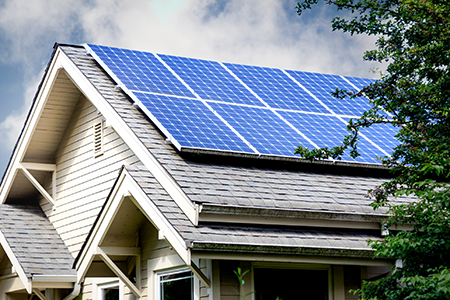
Solar Energy
Solar energy can help power your home or business sustainably and even lower your electric bill. If you’re new to solar and you’re thinking about adding it to your home, watch the video below for some helpful starting tips. You can also check out the rest of this page for more information, including common questions, installation guidance and links to helpful resources.
Are you a new solar customer? Check out our Solar Welcome Packet for an explanation of how your solar generation will be shown on your electric bill.
Plug-in solar will be allowable in Colorado, including the City of Longmont, beginning Jan. 1, 2027. Find out more here about these systems and the City’s requirements for them. Information is also provided in our FAQs below.
Solar Installation Process
The instructions below are for Longmont Power & Communications (LPC) customers only. If you are not an LPC customer and want to set up a solar PV or battery storage system, contact your electric utility company for more information.
Solar Installation inside Longmont City limits
- If you are an LPC customer and live in Weld County, your address falls inside City limits
- If you live in Boulder County, but are unsure if you live within City limits, please contact Boulder County
Click here to apply for a solar PV permit with the City of Longmont’s Building Department
Solar Installation outside Longmont City limits
- If you live in Boulder County, but are unsure if you live within City limits, please contact Boulder County
- For Installations outside city limits, email application, interconnection agreement and power data form to LPC_Field_Engineering_Staff@longmontcolorado.gov
Required Forms
- Interconnection Application & Checklist
- Interconnection Agreement
- One-Line Diagram Example for a Solar Installation
Additional Resources
Distributed Energy Resources (DER) Interconnection Standards
Solar Installers
The City of Longmont does not promote any specific solar installers or contractors to install solar electric systems on customer properties. However, you can find a list of active solar installers on solar installer webpages such as the EnergySage solar listings and the Colorado Solar & Storage Association member directory.
Battery Backups
Adding an energy storage system to your solar installation – also known as a battery backup – increases your positive impact on climate change and helps ensure that you get the best payback for the energy you’re producing. Batteries can soak up excess solar generation during mid-day and discharge the energy in the early evening, when daily demand is peaking and energy generation emissions are at their highest. Batteries can also provide excellent short-term backup power during electric outages. See City of Longmont DER Interconnection Standards for more information on battery permitting standards.
Is Solar Right For You?
Before beginning a solar installation, it pays to do your homework. Click on each of these questions to see if your property is ready to go solar.
Before considering solar, it is important to focus on reducing how much energy your property uses by making energy-efficient upgrades and improving your building envelope. By maximizing your home’s energy efficiency first, you can be sure that the electricity produced by your solar electric system is not lost through leaky ductwork, inadequate insulation, or an inefficient heating and cooling system. Furthermore, if you maximize the efficiency of your home, you will offset more of your home’s consumption with solar or be able to install a smaller solar energy system (reducing your solar installation cost).
The City of Longmont provides energy efficiency resources and rebates through Efficiency Works™. As an LPC customer, you can speak with an expert Efficiency Works Energy Adviser, sign up for an energy audit, and apply for efficiency rebates. Simply visit the Efficiency Works website or call 877-981-1888 to speak with an Energy Advisor today.
If you are considering mounting solar panels to your roof, make sure your roof will hold up as long as the panels will. Solar panels are designed to last over 20 years, and removing and reattaching them to a rooftop can be expensive if you need to repair or replace your roof. It’s best to make any needed roof repairs prior to purchasing a solar electric system.
If you rent or your property is not well suited for solar panels, you might consider subscribing to LPC’s Renewable Power Purchase Program.
Purchasing a solar PV system is a large investment that can take some time to see a return. Consider how long you plan to own your property and how much of a payback you’re likely to see in that time.
Frequently Asked Questions
Solar Basics
Your solar electric system only generates electricity when the sun is shining (unless paired with an onsite energy storage system), but your property still needs electricity on cloudy days and after the sun goes down. LPC provides net metering to all customers who install solar electric systems. Net metering is a billing process that allows customers with solar electric systems to buy and sell electricity to and from LPC. By participating in net metering, a customer can buy electricity when their solar electric system is not producing enough energy to meet the demand of their property, and to sell the excess generation to the grid when their solar electric system is producing more than needed.
Getting Started
You, your contractor, and LPC all play important roles in bringing clean energy to your property:
You: A Prepare your property with an Efficiency Works Energy Audit. Once you have completed efficiency upgrades and/or have decided to move forward with a solar installation, contact a qualified solar contractor.
Contractor: Your contractor will help with a site/roof assessment, recommend system sizing, walk you through all the paperwork needed and provide a bid/cost for the project. LPC recommends getting more than one contractor estimate and choosing the one that best fits your needs. The contractor will then submit a permit application for the project to the Longmont Building Inspection Department (or Boulder County Building if outside city limits).
LPC: Our engineers will review and approve the checklist and one-line diagrams submitted with your application for a building permit. (A sample one-line diagram can be seen here.) Once the installation is complete, LPC will configure your electric meter to measure energy you use from the grid and any energy your solar electric system puts back onto the grid.
LPC does not offer installation services or provide oversight of the installation process; however, we do conduct inspections to ensure that the installation meets our building code and interconnection requirements. Selecting an experienced solar contractor is one of the most important steps in the overall installation process.
The installer can advise you on the pros and cons of buying versus leasing. If you prefer to own your solar installation, you should consult with your tax advisor to determine your eligibility for federal and state tax credits.
Federal tax credits of 30% for home solar installations expired on Jan. 1, 2026. You can also consider these additional resources on federal, state and local incentives for solar PV.
Grants or financing may be available to non-residential property owners through the Colorado Clean Energy Fund, Colorado Commercial Property Assessed Clean Energy (C-PACE), or Partners for a Clean Environment (PACE).
Billing and Usage
Yes. All customers who have their own electric generation equipment, including solar electric system customers, are billed under the applicable self-generation rate for any energy they use from the grid. This customer charge and self-generation rate helps ensure that customers pay their fair share of the electric infrastructure used by the entire community, and accounts for both the energy LPC delivers to the customer and the value of the energy that the customer’s system delivers to LPC. These are recorded on an ongoing basis via advanced meters and our net metering process. Learn more about LPC’s solar billing.
For self-generation customers, most of the fixed costs to manage the electric distribution system are included in the monthly customer charge and removed from the kilowatt-hour (“energy”) charge. This results in a self-generation customer’s fixed monthly customer charge being greater than the charge for a non-self-generating customer, but a decrease in their monthly energy charge. Unlike a customer who only consumes electricity, a self-generating customer uses the electrical distribution system in two ways: drawing power from the grid and putting power back onto the grid. If all fixed costs were collected as part of the energy charge for a self-generating customer, rather than collected as part of the customer charge, it would result in under-collecting for those customers’ share of the electric distribution system costs, as they purchase less energy but utilize the grid in two ways. Since LPC is a not-for-profit customer-owned utility, this would result in other customers subsidizing self-generation customer distribution costs.
The top section of the electric usage detail shows the amount of energy used from LPC’s grid in kWh for the month and the associated charge. The bottom section displays the amount of energy put back onto LPC’s grid in kWh, and the associated credit. This is not the amount of energy your PV system is generating, it is only the amount that your system generates in excess of what you are using at the time of generation. To learn more about LPC’s net billing, please see our Solar Welcome Packet.
The amount of electricity that you receive credit for will likely not match the production shown on your system’s monitoring device. Electricity is only sent back to the grid when your system is generating more than what your property is using at the time. If your property is using all of the electricity your system is generating, there is nothing to send back to the grid and therefore no credit on your bill.
The Longmont City Council has adopted a “value of solar” bill credit to compensate solar customers who generate more electricity than they use. This applies to customers who install new solar or expand their existing systems after Jan. 1, 2025. Customers who had solar installed before that date will continue to have their credits based on the retail electric rate through January 2040. Further details can be found on the Commercial Rates and Residential Rates pages.
Plug-in Solar
Plug-in photovoltaic (PIPV), or “balcony” solar is a small array of solar panels that can be plugged into an outlet, providing power to a home. These systems can help offset the electric usage of appliances and HVAC systems.Following the passage of HB. 26.1007, plug-in solar is allowable in Colorado and Longmont starting Jan. 1, 2027.
No. Allowed plug-in solar systems are 1,920 watts or less and do not require interconnection with the electric grid. This means that even if your plug-in system generates more power than you use, you will not sell back power to LPC or have a credit applied to your electric bill.
Only one system is allowed per address plugged into a single outlet. The system’s maximum power output may not go above 1,920 watts (1.9 kW).
Longmont requires a Notification of Installation for your plug-in solar system. (A link to provide this notice will be coming soon.) In addition:
- The system must be listed for safety compliance by a Nationally Recognized Testing Laboratory (NRTL) such as Underwriters Laboratories. UL 3700 is the standard for this sort of installation.
- The system must conform with the National Electric Code (NEC).
- The panels must be securely fastened.
- The installation must comply with fire code requirements and with applicable building codes that pertain to health and safety.
- The system must automatically disconnect from the grid during a power outage to protect line workers.
For systems that are 1,920 watts or less, you do not need to pay a fee or get a permit UNLESS you’re making changes to your existing electrical equipment.
No. You do not need to get a contractor for systems that are 1,920 watts or less UNLESS you’re making changes to your existing electrical equipment or mounting.
These systems can plug into a standard electrical outlet and may need about 20 square feet of space. A typical 391-watt system will generate about 587 kilowatt-hours of electricity per year, saving about $68 per year on average.
These systems may require circuit or receptacle modifications (see UL 3700 for options) and may require up to 115 square feet of space. Your electrical generation and energy savings will depend on the size. For example, a 500-watt system will typically generate about 750 kilowatt-hours (kWh) of electricity per year, saving about $87 per year on average, while a 1,920-watt system will usually generate about 2,870 kWh per year for an estimated savings of about $335 per year.
No. Solar energy systems of 1,921 watts or more must be installed by a contractor and require an Interconnection Agreement with the City.
Customers should consult with a licensed electrician with questions about their home’s electric service, circuit ratings, or general compatibility with plug-in solar systems. Neither LPC nor the City of Longmont are liable for any damage or injury caused by a portable solar device/system.
LPC will not inspect the system or provide bill credits for energy returned to the grid.
Check with your home insurance provider to understand any implications to your coverage from installing plug-in solar.
For specific questions regarding portable-scale solar, please email Longmont Power & Communications at energystrategiesandsolutions@longmontcolorado.gov.