The City of Longmont Installs New Pedestrian Crossing Signal
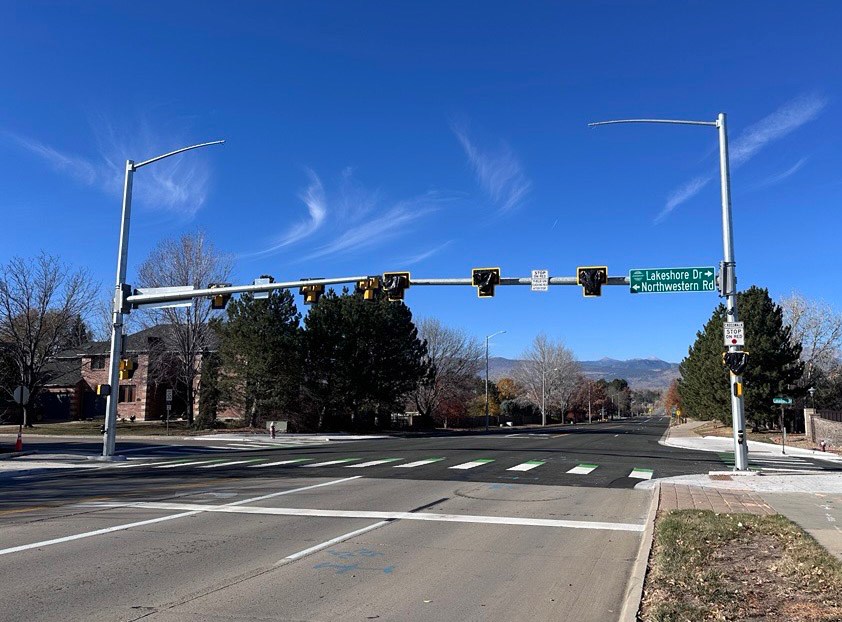
The City of Longmont installed a High-Intensity Activated CrossWalk (HAWK) to help pedestrians safely cross 17th Avenue at the Lakeshore Drive/Northwestern Road intersection. Scheduled to be activated on Tuesday, November 17th, the HAWK signal will be the first of its kind in Longmont.
A HAWK signal looks like a standard traffic signal; however, the three-light sections are arranged in a pyramid shape instead of a line. If you’ve never encountered a HAWK signal on the road, the City of Longmont encourages you to watch the HAWK (High-Intensity Activated CrossWalk) Signals video created by the City of Firestone.
How does a HAWK signal work?
For pedestrians, the HAWK signal experience is very similar to a crossing at a traffic light. Pedestrians will press the crossing button and wait for the walk symbol to indicate it is safe to cross. Pedestrians should not cross 17th Avenue if they see a red symbol of a hand.
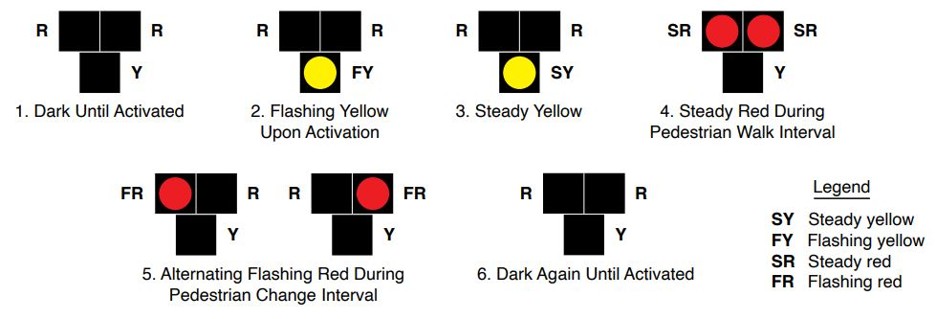
Sequence of HAWK signals from U.S. Department of Transportation
- No lights – No action is needed; motorists and cyclists can continue on with no change.
- Flashing yellow lights – A pedestrian has activated the signal. Drivers and cyclists should be alert and begin to slow down and prepare to stop.
- Solid yellow lights – Drivers and cyclists must prepare to stop.
- Solid red lights – Drivers and cyclists must come to a complete stop.
- Pedestrians receive the walk signal and begin crossing the road.
- Duel flashing red lights – Drivers must come to a complete stop. After stopping, drivers may proceed when the crosswalk is completely clear.
- The pedestrian crossing phase is complete.
Installation of protected pedestrian crossings like the HAWK signal is an example of Longmont’s effort to improve traffic safety for everyone who walks, bikes, drives or takes public transportation.