E-Powered Bike. Shared Roads. Real Rules. These e-powered bikes, regardless of the rider’s age, are subject to traffic safety laws.
E-bikes are broken into three classifications: Class 1, 2, 3
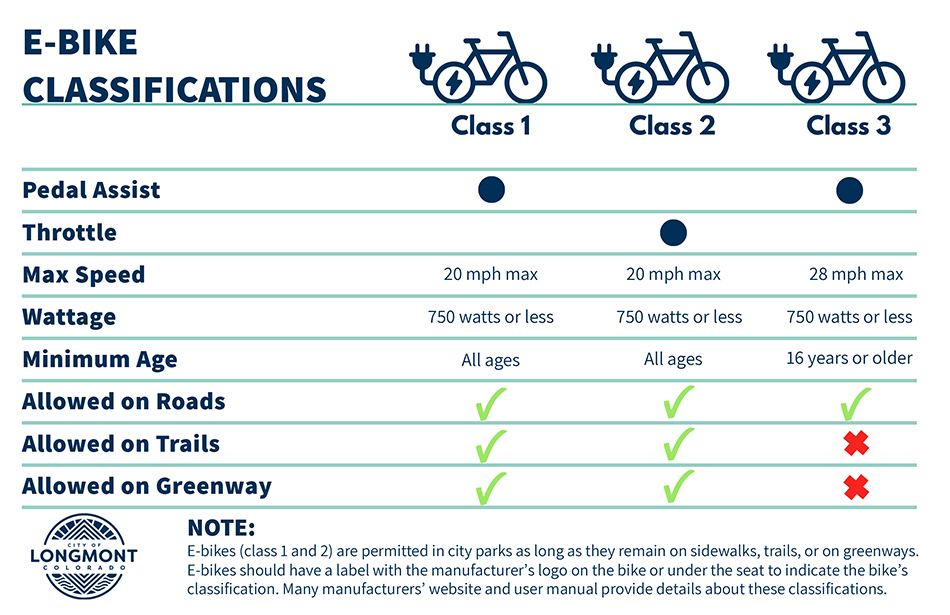
NOTE: E-bikes (Class 1 and 2) are permitted in city parks as long as they remain on sidewalks, trails, or on greenways.
E-bikes should have a label with the manufacturer’s logo on the bike or under the seat to indicate the bike’s classification. Many manufacturers’ websites and user manuals provide details about these classifications.
E-Motos
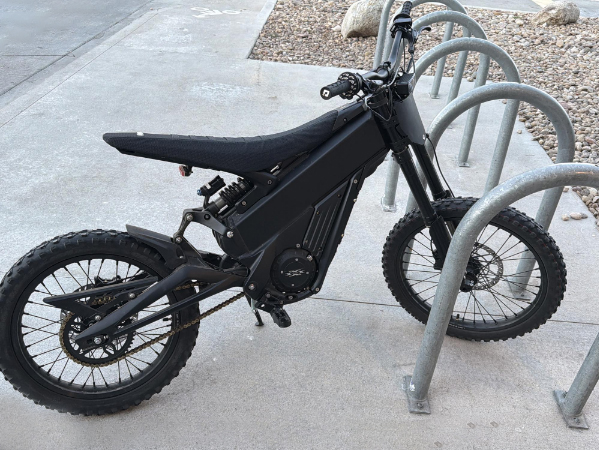 An e-moto is technically a motorcycle that requires riders to be at least 16 years of age and to hold a Motorcycle (M) endorsement driver’s license. E-Motos must be registered and insured and are permitted on city streets only. An e-moto (electric dirt bike) does not have a single standard motor size. Because they are designed for high-performance off-road use rather than street commuting, their motor capacities (measured in continuous/peak watts or kilowatts) are much higher than those of traditional e-bikes and include anything over 4,476 watts.
Most popular e-motos feature motor outputs ranging from 5,000W (5 kW) to over 20,000W (20 kW).
Low Power Scooters
Low-Power Scooter is a self-propelled vehicle designed primarily for use on roadways with not more than three wheels in contact with the ground, no manual clutch, and either of the following:
- A cylinder capacity not exceeding fifty cubic centimeters (50cc), if powered by internal combustion, or A wattage not exceeding four thousand four hundred seventy-six (4,476), if powered by electricity.
- A Low-Power Scooter does not include a toy vehicle, bicycle, electric-assisted bicycle, wheelchair, or any device designed to assist mobility-impaired people who use pedestrian right-of-ways.
- Requires a driver’s license, registration, and insurance.
What parents should know:
- Parents can face criminal charges for allowing, aiding, or encouraging a minor to operate an e-bike or e-moto illegally. Delinquency of a minor – class one misdemeanor – CRS 18-6-701
- Youth fleeing on e-powered bikes when officers arrive can be charged with eluding. This is dangerous for both the rider and the community. We are identifying youth that flee officer contact.
- Any modification to an e-bike that is not part of the original equipment provided by the manufacturer does not qualify as an e-bike under state definition (increased speed, removal of pedals, removal of the bike chain, etc.).
- Any e-bike over 750W is not a legal e-bike in Colorado. E-bikes 750-4,476W are classified as low-power scooters and require a driver’s license, with a motorcycle endorsement, insurance, and registration.
- Riders under 18 years old must wear a bicycle helmet when riding a Class 3 e-bike.
- A person under sixteen years of age can not operate a class 3 electrical assisted bicycle; except that a person under sixteen years of age may ride as a passenger on a class 3 electrical assisted bicycle that is designed to carry passengers.
Traffic Laws For E-Bike Riders
Know the Rules. Ride Responsibly.
- Only carry the number of passengers your e-bike is designed for.
- Ride in the right-hand lane unless passing another vehicle or making a left turn.
- Ride no more than two side-by-side.
- Keep at least one hand on the handlebars at all times to maintain control.
- Use proper hand signals before stopping or turning.
- Always yield to pedestrians and share the road and trails safely.
Share Information About Unsafe E-Moto Activity:
Other useful links:
- HB17-1151: E-Bike Classification
- Colorado DMV: Low Power Scooter
- Bicycling – City of Longmont
- People for Bikes: The E-Moto Problem
- Bicycle Colorado: E-bikes
- CDOT: E-Bike Safety Campaign
Public E-bike Share by BCycle
The City of Longmont introduced a new public e-bike share program as part of a regional network powered by BCycle. The program provides e-bikes for short-term, on-demand rentals from self-serve docking stations.