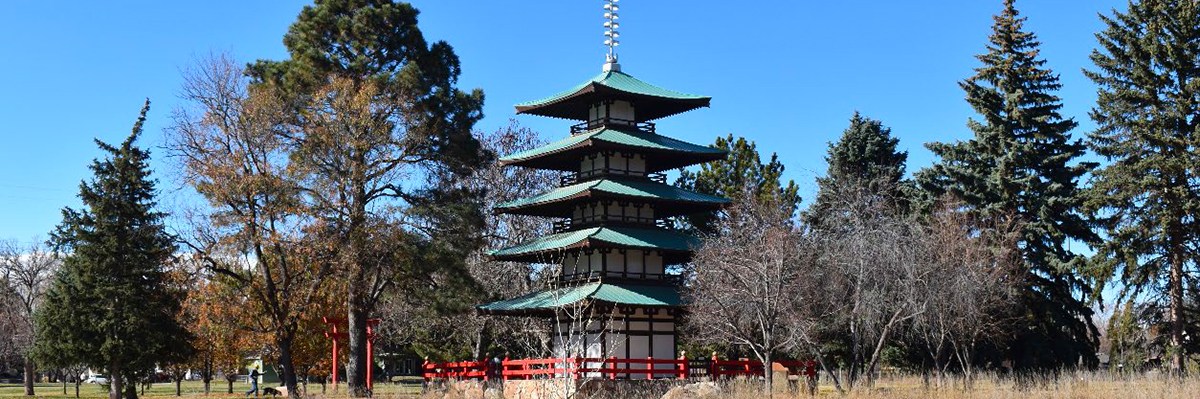
Tower of Compassion
The Tower of Compassion has stood in Longmont’s Kanemoto Park (1151 S. Pratt Parkway) since 1973. Its five stories represent five levels of compassion: love, empathy, understanding, gratitude and selfless giving.
The tower was created by the Kanemoto family and given to the people of Longmont. This was done in gratitude for the compassion and support the family received, particularly during the difficult years surrounding World War II.
Inspired by traditional Japanese pagodas, the tower brings together architecture, family history, and a message that reaches beyond any one culture or faith.
The Kanemoto family’s story in Longmont began in the early 1900s. Goroku Kanemoto came to the United States from Hiroshima, Japan, in 1907. He settled south of Longmont, where he worked on farms before starting a farm of his own with his family.
Goroku and his wife, Setsuno, raised three children: Tsutomo, Fumiko, and Kiyoshi, who later became known as Jimmie, Faith, and George.
The family became an important part of Longmont’s farming and business community. In 1937, they opened Freshway Market on South Main Street, where they sold locally grown produce. Jimmie and George later started other businesses and helped develop land south of Longmont.
Their connection to the community would inspire a lasting gift.
During World War II, Japanese Americans faced persecution because of their ancestry. After Japan attacked Pearl Harbor in 1941, the U.S. government forced many Japanese Americans from their homes and sent them to internment camps. One of these camps, Amache, was in southeastern Colorado.
The Kanemoto family stayed in the Longmont area but faced restrictions and discrimination. Even during this difficult time, neighbors and other community members showed the family kindness and support.
The Kanemotos never forgot that help. Decades later, they created the Tower of Compassion to thank the community.
In the 1960s, brothers Jimmie and George Kanemoto developed much of their family’s land south of Longmont into the Southmoor Park neighborhood. The family also donated land for a public park and an elementary school. The park was named Kanemoto Park in honor of their father, Goroku.
The idea for the tower came from Jimmie and his wife, Chiyo, after they visited Japan and saw traditional pagodas. George and his wife, Jane, joined them in bringing the idea to life.
The brothers worked with engineer and contractor Reid Burton and local businesses to build the tower. Construction began in 1973. On September 4 of that year, the family gave the completed tower to the City of Longmont.
Today, the seven-acre park has open lawns, mature trees, sports courts, a playground, an activity pool, walking paths, and access to Left Hand Creek.
The Tower of Compassion takes its design from traditional Japanese pagodas but uses modern building materials. Its five levels become smaller as they rise. Each level has a wide roof with green metal panels and dark brown supports. The walls are cream-colored, with dark brown wood trim. A tall metal ornament called a sorin sits at the top.
The tower stands on a raised foundation covered with stone. A low wooden fence with four gates surrounds it.
Nearby, a red torii gate stands along a path west of the tower. A group of cherry trees honors the Kanemoto family, and bronze plaques explain the tower’s history and meaning. One plaque honors Jimmie Kanemoto (1917–2006) and recognizes Longmont’s ties to its sister cities, including Chino, Japan, and Ciudad Guzmán, Mexico.

Together, the tower and its surroundings tell a story of family, friendship, and community.
Jimmie Kanemoto followed the Buddhist faith, but he did not intend the tower to be a religious symbol. Its message was meant for everyone, no matter their culture or beliefs.

The tower’s five levels show how compassion can grow from caring for others to giving without expecting anything in return.
- Love: Care for others and value each person.
- Empathy: Try to understand how others feel.
- Understanding: Recognize how our lives connect with one another.
- Gratitude: Be thankful for the people and places that support us.
- Selfless Giving: Help others without expecting a reward.
These values invite us to think about how we treat others and how we can make our community stronger.
More than 50 years after the Kanemoto family gave the tower to Longmont, it remains an important part of Kanemoto Park.
People walk along Left Hand Creek, children play nearby, and visitors stop to admire the tower and read its plaques. The tower connects everyday life in the park with the story of a family that built a life in a new country and remembered the kindness shown to them.
The Tower of Compassion began as a thank-you. Today, it continues to share a message that matters to everyone: Live with compassion, remember the kindness of others, and give back to your community.