Sign Permits
Overview
Sign standards regulate the number, size, placement, and to some extent, design of signs in Longmont. See below for additional information on sign types and permitting.
Permits for signs are processed by City of Longmont Development Services in the Development Services Center at 385 Kimbark Street, Longmont CO 80501.
For specific questions about the Sign Code, email Rebecca Ahlfinger or call 303-651-8695.
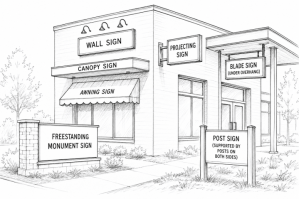
All permanent signs require review and approval prior to installation. Permanent sign types include but are not limited to the following:
- Wall Sign
- Canopy Sign
- Awning Sign
- Freestanding Monument Sign
- Projecting Sign
- Blade Sign
- Post Sign
Submittal Information:
- Submittals
- Email Code Enforcement to submit a completed sign application packet. Sign Permit Applications must include the following:
- Name of Business – to include address and telephone number
- Property owner – to include address and telephone number
- Sign Contractor information – to include sign contractor’s current license
- Electrical Contractor information – to include current license
- Site plan clearly showing location of signs on building and/or location of freestanding signs on property
- Architectural drawings with design renderings of signs and their location on building wall
- Architectural stamped plans with current dated stamp
- Electrical depiction of sign if applicable
- Email Code Enforcement to submit a completed sign application packet. Sign Permit Applications must include the following:
- Review Process
- The permit is assigned a number, and an email is sent to the POC listed on the application informing them the permit has been assigned for review. Once assigned, and the permit has been deemed completed, the review process usually takes approximately 14 days – please note this in an estimated timeframe and can fluctuate based on review comments. When the permit is approved, an email is sent to the POC stating the permit is ready for issuance upon payment and any remaining delinquencies.
- Incomplete or outdated information will result in permit process or permit issuance delays.
- Fees, Permit Issuance, and Completion
- Fees are based on the specific size and material of sign which makes each cost unique.
- Permits will be issued upon payment and completed/closed once all inspections have been approved.
Temporary signs listed below require a Temporary Sign Permit.
-
Banners
- Shall not exceed sixteen (16) square feet in area. No more than one per business applicant and professionally printed on durable material.
-
Feather flags/wind signs
- This type of temporary sign includes ground mounted flexible frame with “feather like” flag attachment.
- Shall not exceed twelve (12) feet in height and must be set back from property line equal to the height of the flag.
- A maximum of three (3) are allowed per property with a maximum of one for every 75 feet of business street frontage.
-
Windsocks
- This includes a sign consisting of a vertical tube that moves with pressure from mechanically blown air.
- Shall not exceed fifteen (15) feet in height.
- Must be set back from property line equal to the height of the wind sock.
- Maximum of one (1) per property.
-
Portable A-frames
- Sign boards shall be no taller than 4 feet in height and no more than six square feet in area.
- Maximum of one per business.
-
Pennants
- Shall be no taller than the height of the permanent structure to which they are attached.
-
Prohibited Temporary Signs include:
- Off-premise signs of any design
- Inflatable figures
- Moving or fluttering signs
- Signs attached to utility poles or placed in the right-of-way
- Any signs displayed in the right-of-way or attached to utility poles are in violation of code requirements and may be removed from the public right-of-way by Code Enforcement without prior notice.
Submittals
- Temporary sign permits can be obtained by completing the temporary sign permit and paying the application fee. Often, Temporary Sign Permits can often be issued the same day as application.
- To submit a Temporary Sign Permit, email Code Enforcement the completed Temporary Sign Permit Application.
- To submit in person, bring the completed application to:
City of Longmont Development Services Center
385 Kimbark Street
Longmont, Colorado 80501 - Fees
- Temporary Sign Permits are $10.00/per quarter or $40.00 for the entire calendar year. The permit is only good for the time specified on the application and must be renewed at the end of the quarter of the year in which the permit was issued.
- Fees will be collected prior to issuance of the Temporary Sign Permit. The permit reviewer will provide instructions on how to pay.
- To pay in person, checks are accepted. Online payments are allowed. Prior to issuance, the plan reviewer will contact you with instructions to pay online.
- Permit issuance
- Once the application is approved and payment completed, the sign can be installed.
- You must receive the permit from the city before installing your sign.
For specific questions about the Sign Code, email Rebecca Ahlfinger or call 303-651-8695.
Section 15.06.020 outlines signs which are exempt from permitting requirements.
The following non-illuminated signs may be erected in compliance with this chapter without the issuance of a sign permit. Such signs may be allowed in addition to all other signs permitted and shall conform to setbacks, height, and other applicable requirements of this chapter.
-
Yard Signs
- Shall not exceed two per property at any one time
- Shall not exceed 12 square feet per sign in the R-RU, R-SF, R-MN, and R-MH zoning districts, and shall not exceed 32 square feet per sign in all other zoning districts
- Shall not exceed a height of four feet in the R-RU, R-SF, R-MN, and R-MH zoning districts, and shall not exceed a height of eight feet in all other zoning districts
-
Flags
- Any flag affixed to a permanent flagpole or affixed to a building, not including feather flags, is allowed and is exempt from the sign permit requirement provided the area of the flag shall not exceed 32 square feet in the R-RU, R-SF, R-MN, and R-MH districts. In mixed-use and nonresidential zoning districts, flags and flag structures may extend up to five feet over the maximum height allowed in the underlying zoning district.
-
Window Signs
- Window signs are allowed and are exempt from the sign permit requirement, provided window signage does not cover more than 25 percent of a window opening or 50 percent of any one window panel if a window opening contains multiple window panels.
-
Signs located inside a building
- Signs located inside a building are allowed and are exempt from the sign permit requirement provided any interior sign within six feet of any window shall not have any flashing or moving lights, including video monitors and electronic message signs.
-
Integral signs
- Any inscription carved into stone or similar material that is integral to a building, such as is commonly found on cornerstones or stamped into sidewalks, is allowed and is exempt from the sign permit requirement. Such integral signs shall not exceed 12 square feet in area.
Section 15.06.030 outlines prohibited signs. The following signs are prohibited in the City of Longmont:
-
Distracting, interfering, or confusing signs
- Signs that cause visual obstruction or interfere with motor vehicle traffic or a traffic control device, including any sign that obstructs clear vision in any direction from any street intersection or driveway.
- Signs employing a lighting or control mechanism that causes radio, radar, or television interference.
- Signs that obstruct any fire escape, window, door, or opening used or required as a means of egress or ingress, or for emergency purposes, or that interfere with any openings required for light or ventilation.
- Signs in rights-of-way or on other public property unless specifically permitted or provided for in this chapter.
-
Animated or Moving Signs
- Animated or moving signs except for scoreboards for athletic events, time and temperature devices, electronic message signs used by the city or other public agency to address a health or safety matter or public service announcement or permitted electronic message signs.
- Inflatable signs such as balloons and inflatable figures, or other similar moving, fluttering, or revolving devices.
- Pennants and windsocks, unless approved with a temporary sign permit.
-
Feather Flags and similar devices, unless approved with a temporary sign permit
-
Neon or LED lighting Signs
- Neon or LED lighting not within the lettering or logo of a sign shall be subject to both Section 15.05.140 and Section 15.06.040.
-
Portable Signs
- Portable signs, except as authorized in section 15.06.040.G.
- Signs on parked vehicles or trailers unless
- Such vehicle or trailer is operational, currently registered with current tags, and parked in a functional parking space or behind a primary building;
- Such signs are not located on top of a vehicle, except for delivery vehicles; and
- Such signs are not electronic message signs.
- Portable signs, except as authorized in section 15.06.040.G.
-
Roof-Mounted Signs
- Roof signs or any portion of a sign or sign cabinet or frame extending above the parapet or roof eave, except for historic signs on historic landmarks.
-
Posters, handbills, and painted signs
- Signs painted on or attached to fences.
- Signs attached to utility poles or other poles or structures, except bus stop signs, within public rights-of-way.
-
Off-premises signs
-
Abandoned or inoperable signs
- Inoperable, unsafe, malfunctioning, unrepaired or dilapidated signs.
- Unused or abandoned signs, including any pole, post, or structure supporting such sign.
-
Signs within the sight distance triangle
- To preserve sight distance, an unobstructed view shall be maintained within sight distance triangles as follows:
- Sight distance requirements are addressed in Chapter 15.10 under the definition of the term “sight distance triangle” and in the city standards.
- No signs, except traffic signs, shall exceed a height of 36 inches above the grade of the lower roadway within a sight distance triangle.
- Sign projection or overhang across a sight distance triangle shall be permitted only when the bottom of the sign surface is a minimum of nine feet above the grade of the higher roadway given that the supports also meet standards.
- To preserve sight distance, an unobstructed view shall be maintained within sight distance triangles as follows: